Madrid9h
Avila y Segovia Full Day Tour from Madrid
4.6(5)
From€51.00
/ person
 1 / 9
Explore Madrid's grandest imperial-era landmarks and palaces on a guided 2-hour walking tour through the heart of the Spanish capital. Learn the stories behind the city's most significant historical sites while discovering insider recommendations for further exploration on your own.
Discover the heart of Madrid on a fascinating 90-minute walking tour through its most iconic landmarks, magnificent architecture, UNESCO World Heritage sites, and legendary literary streets, accompanied by an Official Local Guide.
Madrid is a city where history, art, politics, literature, and everyday life come together in extraordinary ways. Behind its grand monuments and elegant boulevards lie fascinating stories of kings and queens, brilliant writers, artistic rivalries, political intrigue, and centuries-old traditions. On this unforgettable Madrid walking tour, you'll discover how the Spanish capital evolved from a historic royal city into one of Europe's most vibrant cultural destinations.
Our journey takes us through the monumental heart of Madrid, where the city's impressive architecture reflects the ambitions of the Spanish monarchy during the Enlightenment. One of its most recognizable symbols is the magnificent Puerta de Alcalá, commissioned by King Charles III and completed in 1778. Designed by the celebrated architect Francesco Sabatini, this spectacular neoclassical monument once marked one of the main entrances to Madrid. Today, its imposing arches and elegant sculptures stand as a reminder of the city's transformation into a modern European capital.
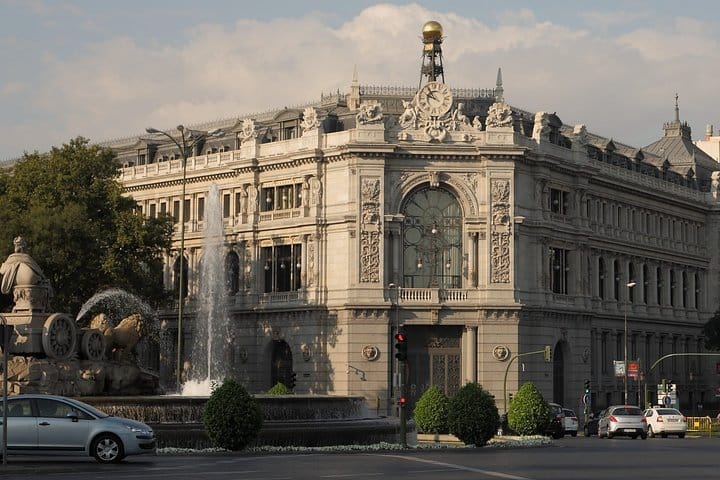
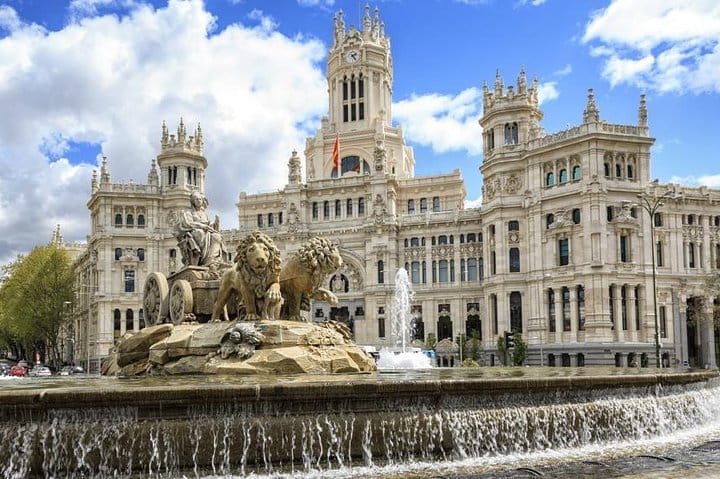
As we explore this remarkable area, we'll discover Plaza de Cibeles, one of Madrid's most beautiful and photographed squares. At its center stands the magnificent Cibeles Fountain, an 18th-century masterpiece depicting the goddess Cybele riding a chariot pulled by two lions. Surrounded by some of the city's most impressive buildings, including Buenavista Palace, Linares Palace, and the Bank of Spain, the square offers an extraordinary introduction to Madrid's architectural heritage.
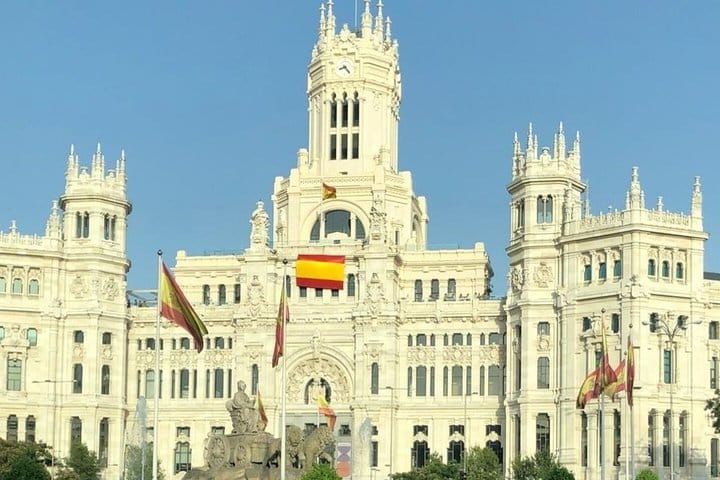
Dominating the skyline is the spectacular Palacio de Cibeles, formerly known as the Palace of Communications and now home to Madrid City Hall. Its magnificent white façade has made it one of the city's most recognizable landmarks. But Cibeles is much more than a historic monument: it is also a symbol of Madrid's passion for football. This is where Real Madrid fans gather to celebrate their team's greatest victories, transforming the square into a sea of excitement and celebration.
Our journey continues along the elegant Paseo del Prado, one of Europe's earliest tree-lined promenades and a remarkable example of historic urban planning. Originally conceived as a place for leisure, recreation, and social gatherings, this magnificent boulevard gradually became one of the most important cultural spaces in Spain.
Today, the Paseo del Prado forms part of Madrid's celebrated Landscape of Light (Paisaje de la Luz), recognized by UNESCO as a World Heritage Site for its exceptional connection between art, science, architecture, and nature. Walking along this historic avenue, you'll understand why Madrid is considered one of Europe's great artistic capitals.
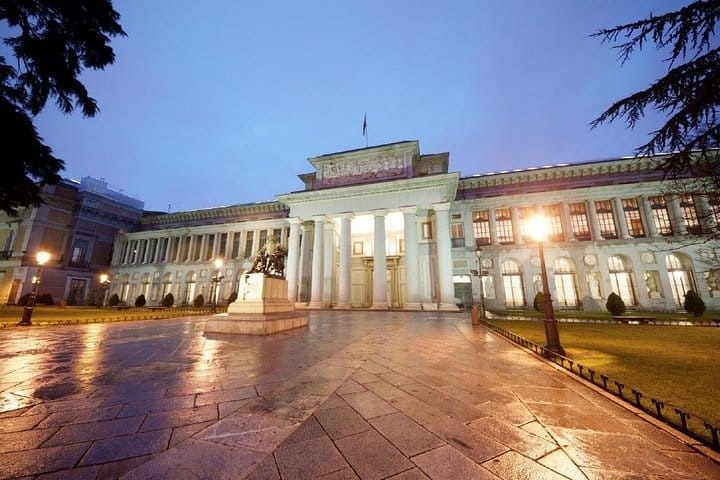
This is the famous Paseo del Arte (Art Walk), where some of the world's most prestigious museums are located, including the legendary Prado Museum, home to masterpieces by Velázquez, Goya, and other great European artists, and the Thyssen-Bornemisza National Museum, renowned for its extraordinary collection of Western art.
But the Paseo del Prado is also an open-air gallery of magnificent monuments. Three impressive 18th-century fountains give this historic boulevard its distinctive character: the Cibeles Fountain, the elegant Apollo Fountain, and the spectacular Neptune Fountain.
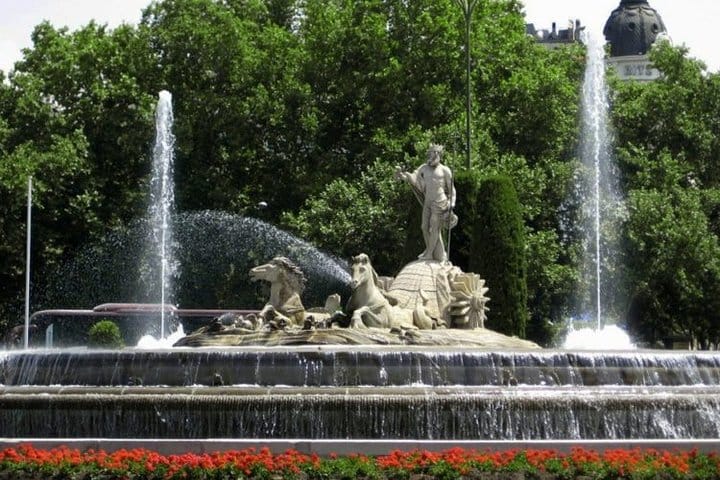
As we reach Plaza de Cánovas del Castillo, we'll discover the magnificent Neptune Fountain, depicting the Roman god of the sea standing in a chariot pulled by seahorses. This impressive monument is one of Madrid's finest examples of neoclassical sculpture and holds a special place in the hearts of football supporters.
While Real Madrid celebrates at Cibeles, Atlético de Madrid fans gather around Neptune Fountain to celebrate their team's most important triumphs. Two legendary football clubs, two magnificent fountains, and one city united by its passion for the beautiful game.
From this remarkable square, we'll also admire the surroundings of the Prado Museum, the historic Church of San Jerónimo el Real, and the nearby Monument to the Fallen, discovering how centuries of art, religion, and political history have shaped this extraordinary part of Madrid.
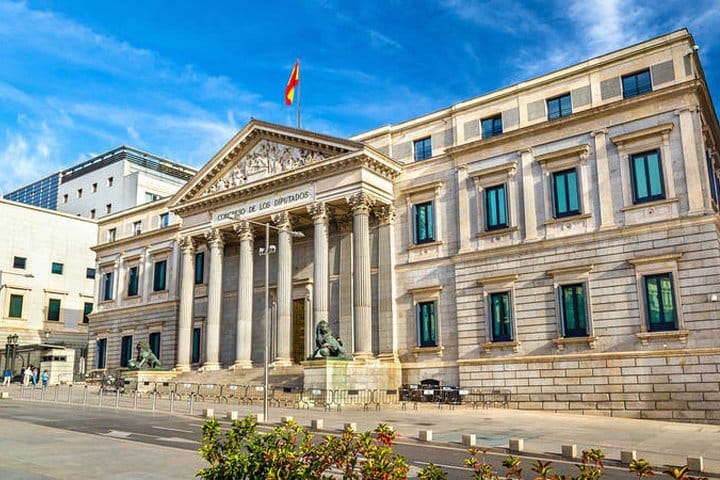
As our walk continues, the magnificent buildings of the Spanish capital reveal another fascinating side of its history: politics and power. At Plaza de las Cortes, we'll find the impressive Congress of Deputies, the lower house of the Spanish Parliament.
Inaugurated in 1850, this monumental neoclassical building is famous for its grand Corinthian columns and the two bronze lions guarding its entrance, popularly known as Daoíz and Velarde. Here, we'll discover the history of Spain's parliamentary institutions, the evolution of its democracy, and some entertaining anecdotes about political life in Madrid.
And since Madrid is also a city of humor and irony, perhaps this is the perfect place to remember the legendary story of Ali Baba and the Forty Thieves. In the famous tale, a secret cave hides an enormous treasure and opens only when someone pronounces the magic words, "Open Sesame!"
Standing before the Spanish Parliament, we might imagine a rather amusing Madrid-style version of the story. The difference is that here, the doors open through democratic elections, and the treasures entrusted to those inside should be the rights, freedoms, and well-being of the Spanish people. And as for the forty thieves… well, we'll leave that to your imagination!
But Madrid's history is not written only in its palaces, monuments, and political institutions. Some of its greatest treasures are hidden in the narrow streets where the most brilliant minds in Spanish literature once lived, worked, argued, and created masterpieces that would change the literary world forever.
Our journey now takes us into the enchanting Barrio de las Letras (Madrid's Literary Quarter), one of the city's most charming and historically significant neighborhoods. During Spain's celebrated Golden Age of Literature, this district became home to an extraordinary concentration of writers, poets, and playwrights whose works continue to influence world literature.
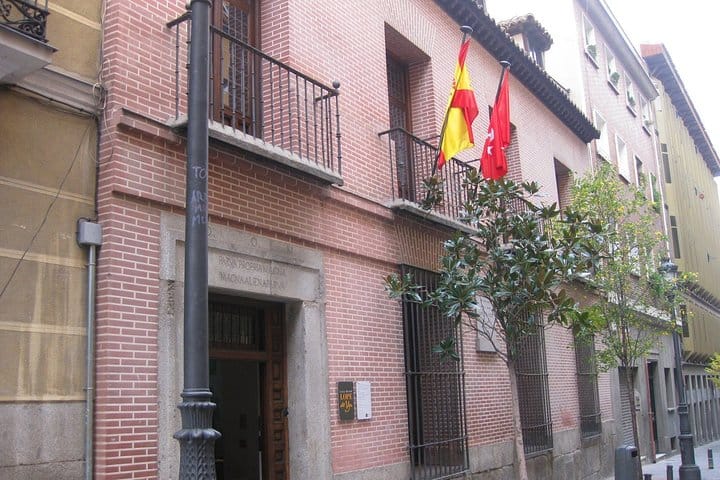
Imagine walking through the same streets once frequented by Miguel de Cervantes, the legendary author of Don Quixote, widely regarded as one of the greatest novels ever written. Discover the fascinating life of Lope de Vega, one of Spain's most prolific and successful playwrights, whose historic house still stands in the neighborhood.
But these literary geniuses were not always friends. Madrid's Golden Age was also filled with fierce rivalries, intellectual disputes, and wonderfully sharp exchanges of insults. Your guide will reveal the legendary literary battles between Francisco de Quevedo, famous for his biting satire, and Luis de Góngora, celebrated for his sophisticated poetry. Their rivalry became one of the most entertaining chapters in Spanish literary history.
As we wander through the picturesque streets of the Barrio de las Letras, you'll discover literary quotations engraved into the pavement, historic façades, traditional taverns, and charming squares that preserve the atmosphere of old Madrid.
And the literary story doesn't end with Spain's Golden Age. The neighborhood also has a fascinating connection with Ernest Hemingway, the legendary American writer and Nobel Prize winner who developed a deep affection for Madrid, its lively cafés, traditional restaurants, bullfighting culture, and unforgettable atmosphere.
Hemingway's passion for Spain helped introduce generations of international readers to the country's traditions, people, and history. Through his stories, Madrid became more than a destination: it became a place of inspiration, adventure, and literary imagination.
Throughout this 90-minute guided walking tour of Madrid, your Official Local Guide will connect these extraordinary places through engaging stories, surprising historical facts, cultural insights, and entertaining anecdotes that reveal the true personality of the Spanish capital.
From the grandeur of Puerta de Alcalá and Plaza de Cibeles to the artistic treasures of Paseo del Prado, the political history of the Spanish Parliament, and the literary legends of Barrio de las Letras, you'll discover a Madrid that goes far beyond its monuments.
This experience is not simply about seeing famous landmarks. It's about understanding the stories behind them, discovering the people who shaped the city, and experiencing the unique combination of history, culture, art, literature, and local traditions that makes Madrid so unforgettable.
With Fun And Tickets, you'll explore the city alongside an Official Local Guide who brings Madrid's history to life with knowledge, passion, and authentic local insight.
Don't just visit Madrid. Discover its stories, experience its history, and fall in love with its extraordinary character. Book your Madrid Highlights & Literary Quarter Walking Tour today and experience the very best of the Spanish capital in just 90 minutes!
Early morning (8–10 a.m.) offers the best light and fewest crowds around the palaces. Spring (April–May) and autumn (September–October) provide comfortable walking weather.
Top-rated, great-value activities in Madrid